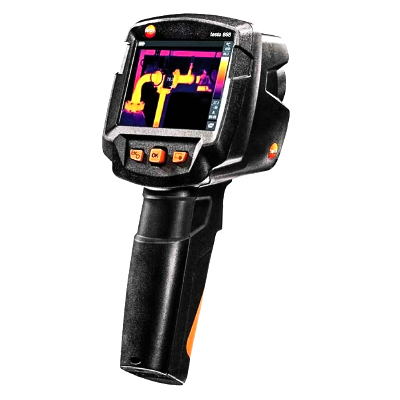
Testo 868 Thermal Imager Price in Bangladesh
The Testo 868 Thermal Imager is designed to help professionals identify temperature differences and detect potential problems through infrared imaging, making the Testo 868 Thermal Imager Price in Bangladesh a relevant consideration for engineers, technicians, maintenance teams, and industrial inspection professionals. By displaying thermal patterns across equipment and surfaces, this instrument supports faster visual assessments without requiring direct contact with the inspected object. Its practical design makes it suitable for routine maintenance, electrical inspections, building diagnostics, and various troubleshooting tasks where temperature distribution provides useful information.
Key Features of the Testo 868 Thermal Imager
The Testo 868 combines infrared temperature measurement with a thermal image display to help users investigate heat-related issues. Its features support everyday inspection activities in commercial, residential, and industrial environments.
Key features include:
-
Infrared thermal imaging for visualizing temperature differences across surfaces and components.
-
Thermal image analysis to help identify unusual heating patterns during inspections.
-
A practical handheld design for convenient use during maintenance and troubleshooting.
-
Image documentation capabilities to support inspection records and technical reporting.
-
Wireless connectivity features, depending on the supported application and configuration, for compatible workflows.
These capabilities help technicians investigate potential faults and prioritize areas that require closer examination. Actual performance depends on operating conditions, surface properties, measurement settings, and the instrument's specifications.
Applications of the Testo 868 Thermal Imager
The Testo 868 Thermal Imager can support a range of professional inspection tasks where heat distribution provides valuable diagnostic information. It helps users identify areas that may need further investigation without physically touching the inspected surface.
Common applications include:
-
Electrical inspections: Identifying unusual heating around electrical panels, connections, distribution equipment, and other accessible electrical components.
-
Industrial maintenance: Investigating motors, machinery, mechanical assemblies, and production equipment for abnormal temperature patterns.
-
Building diagnostics: Examining walls, ceilings, windows, and other building elements for thermal irregularities that may indicate insulation issues or air leakage.
-
HVAC inspections: Assessing heating and cooling systems, accessible pipework, and thermal distribution across relevant components.
-
Preventive maintenance: Recording thermal observations to help maintenance teams identify developing problems and plan follow-up inspections.
Thermal imaging indicates surface temperature patterns and does not automatically confirm the underlying cause of a fault. Further testing may be necessary to establish a diagnosis.
Benefits of Using the Testo 868 Thermal Imager
Thermal imaging can make inspection work more efficient by allowing users to scan larger areas and identify temperature differences visually. The Testo 868 supports maintenance activities by providing thermal information that may not be apparent during an ordinary visual inspection.
Important benefits include improved visibility of heat-related irregularities, convenient inspection of accessible components, and support for preventive maintenance planning. Thermal images can also help technicians communicate findings to colleagues, supervisors, and customers.
For industrial facilities, identifying unusual heating early may help maintenance teams investigate equipment before a minor issue develops into a more serious failure. In building inspections, thermal patterns can help identify areas requiring further assessment for insulation, moisture-related concerns, or uneven heating and cooling.
The effectiveness of these benefits depends on correct instrument operation, suitable environmental conditions, appropriate measurement settings, and professional interpretation of the results.
Operating Guide for the Testo 868 Thermal Imager
Correct operation helps users obtain meaningful thermal images and make more reliable inspection decisions. Before beginning, read the manufacturer's operating instructions and become familiar with the instrument's controls, settings, and safety recommendations.
A general operating procedure includes the following steps:
-
Prepare the instrument: Check the device condition, battery status, lens cleanliness, and available storage or connectivity settings.
-
Configure the measurement: Select suitable settings for the inspected material and measurement conditions, including emissivity where applicable.
-
Position the camera: Hold the thermal imager steadily and aim it toward the inspection area from a suitable distance.
-
Capture thermal images: Scan the target area and record images that show relevant temperature differences.
-
Review the results: Examine the thermal patterns and compare suspicious areas with appropriate reference points or known operating conditions.
-
Document findings: Save relevant images and record inspection details to support maintenance reports and future comparisons.
For electrical inspections, follow appropriate electrical safety procedures and maintain safe distances from energized equipment. Thermal imaging should complement, rather than replace, other required inspection and diagnostic methods.
Build Quality, Handling, and Maintenance
The Testo 868 is intended for practical thermal inspection work in professional environments. Proper handling and routine care help preserve its functionality and support consistent inspection results.
Keep the infrared lens clean and protected from scratches, dust, and contamination. Store the instrument in suitable conditions and avoid exposure beyond its specified environmental limits. Inspect the housing and accessories regularly, and follow the manufacturer's guidance for battery care, cleaning, software compatibility, and servicing.
Measurement reliability also depends on understanding the limitations of infrared technology. Reflections, surface emissivity, viewing angle, distance, and environmental temperature can influence readings. Users should account for these factors when evaluating thermal images, especially during critical electrical, industrial, or building inspections.
For demanding applications, follow the manufacturer's maintenance recommendations and arrange appropriate technical checks when necessary.
Why Choose the Testo 868 Thermal Imager in Bangladesh?
Engineers and maintenance professionals in Bangladesh may need reliable thermal inspection tools for factories, commercial buildings, electrical installations, workshops, and industrial facilities. The Testo 868 offers a practical way to visualize surface temperature differences and document potential problem areas during routine inspections.
When selecting a thermal imager, buyers should assess the required temperature measurement range, thermal image quality, measurement accuracy, reporting workflow, connectivity, and compatibility with their inspection tasks. It is also important to confirm product authenticity, included accessories, warranty coverage, and access to after-sales assistance.
Choosing an instrument based on actual application requirements helps ensure that it supports the intended inspection work. Buyers should verify the available specifications and configuration with the supplier before making a purchasing decision.
Buying Guide for the Testo 868 Thermal Imager
Before purchasing the Testo 868 Thermal Imager in Bangladesh, consider the type of inspections you perform, the level of detail required, and the environment in which the camera will operate.
Evaluate the following points:
-
Application suitability: Confirm that the camera meets your electrical, mechanical, HVAC, or building inspection requirements.
-
Technical specifications: Review thermal sensitivity, temperature measurement range, accuracy, image resolution, and supported measurement functions using the official product documentation.
-
Software and connectivity: Check compatibility with your computer, mobile device, or preferred reporting process.
-
Product authenticity: Request the model identification, documentation, and confirmation of product origin.
-
Warranty and service: Verify the written warranty conditions, technical support availability, and service arrangements.
-
Included accessories: Confirm which accessories, cables, storage options, and documentation are supplied with the unit.
A qualified supplier can help clarify these requirements and provide a quotation based on the product configuration and availability.